Betting on Chaos
How Real-World Unpredictability is Reshaping the Gaming Frontier:
For the past decade, the UK online casino and gambling sector has been running a tired playbook. Walk the floor at any major industry trade show, and the story is identical: thousands of virtual slot titles featuring slightly tweaked mathematical models wrapped in fresh graphic skins, alongside digitised table games that haven't fundamentally changed since the dot-com boom.

Meanwhile, British players, specifically the mobile-native generation raised on Twitch, TikTok Live, and micro-content, are showing clear signs of product fatigue. With the UK Gambling Commission enforcing online slot stake limits (£2 for under-25s and £5 for adults), operators are facing a new reality.
Volume and acquisition are up, but session intensity and gross gambling yield (GGY) per spin are undergoing structural shifts. The industry cannot simply spin its wheels with more of the same, and the next frontier of growth won't come from another 5x3 video slot. It is coming from an entirely new vertical: Betting on Chaos.
That is why the team at AllGamblingSites is taking a deep dive into this emerging phenomenon. In this comprehensive guide, we unpack what chaos betting actually is, explore the real-world mechanics powering it, and show you where and how to safely navigate this exciting new frontier.
Introducing The New Age "Betting On Chaos" Boom
At its core, "betting on chaos" replaces synthetic server calculations with raw, streamable physical reality. Pioneered by live content studios like 155.io (founded by entrepreneur Sam Jones), this emerging genre turns physical micro-events- from live urban CCTV traffic feeds to kinetic marble runs, floating duck races, and mechanical coin flips into 24/7, high-frequency betting markets. Why is this striking a chord right now?
- The Authenticity Deficit: Modern digital players are naturally sceptical of software Random Number Generators (RNGs) hidden behind remote servers. Watching a physical object ricochet down a track or waiting for a pedestrian to round a corner on a live camera feed offers an immediate visual legitimacy that digital graphics struggle to match.
- Built for Mobile-Native Mechanics: Traditional live dealer games were engineered for desktop landscapes. Chaos games are designed vertically for 155mm mobile screens, offering short 30-to-60-second rounds tailored to brief, on-the-go sessions.
- The Crash Evolution: Crash games proved that players want agency and real-time decision-making. Chaos formats marry that crash-style multiplier tension with live, unscripted physical streams.
What is "Betting on Chaos"?
At its core, Betting on Chaos turns real-world physical randomness into high-frequency, streamable betting feeds. Unlike traditional casino games, which hide their logic inside a "black box" server, or sports betting, which relies on team statistics and historical odds, chaos betting capitalises on pure, visible unpredictability.
The appeal lies in its visceral immediacy: physical systems feature natural friction, environmental variables, and genuine micro-shocks that no computer algorithm can imitate.
155.io: The Studio Championing The 'Chaos' Movement
At the epicentre of this shift is 155.io (155 Media Studios), a game studio founded by entrepreneur Sam Jones. Named after the standard 155mm diagonal screen height of modern mobile devices, 155.io was built on a simple premise: authentic, unscripted real-world Chaos will outperform even the most polished digital content.
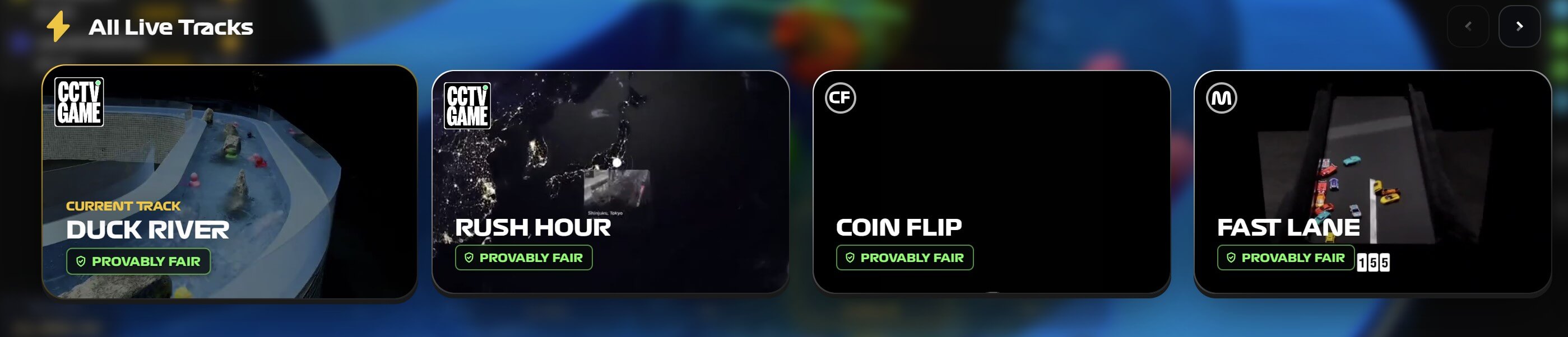
Instead of launching standard slot games or animated table games, 155.io has established entirely brand new (and quite frankly very exciting!) game genres:
CCTV & Real-World Feed Games
155.io introduced the CCTV Game genre, turning live, ambient real-world feeds into fast-paced betting events:
- Rush Hour: Players place bets based on live, real-time traffic footage streamed from cities around the globe.
- Footfall: A crash-style game built around live camera monitoring. The multiplier climbs as long as "nothing happens", and players must cash out before the next pedestrian rounds the corner or crosses a marker.
Physical & Kinetic Chaos
Beyond live video feeds, the studio operates 24/7 physical gaming studios that stream continuous real-world micro-races:
- Duck River & Marble Racing: Robotic release mechanisms send plastic ducks or marbles down complex physical tracks filled with unpredictable obstacles.
- Stairpong, Fish Tank, & Coin Flip: Mechanical devices produce true physical randomness in short, 1-minute rounds that run continuously.
Why Is Chaos Betting Winning Over Players?
The sudden rise of chaos-driven betting highlights several structural changes in online gaming culture:
- Trust Factor Software RNGs hidden inside remote servers: Physical objects or live video feeds visible on screen in real time.
- Pacing Long sports matches or instant single-player spins: Continuous, fast-turnaround 24/7 stream rounds (1-minute cycles).
- Fairness Tech Standard third-party audit certificates: Cryptographic SHA-256 commit-reveal chains verified in-browser.
- Formatted desktop-adapted layouts: Vertical, portrait, stream-first design built specifically for mobile screens.
Stream Culture & Micro-Mechanics
Chaos betting combines the visual thrill of live streaming with modern gaming mechanics:
- Crash & Cash-Outs: Allowing players to lock in winnings mid-event as risk escalates.
- Streak & Boost Multipliers: Random "Lightning Rounds" and rarity drops that layer gaming excitement over physical outcomes.
Cryptographic "Provably Fair" Verification
Modern players are, however, sceptical of digital black boxes. Watching a physical marble ricochet down a track or a car slow down on a real-life camera feed offers a level of visual transparency that digital graphics cannot match.
Because physical events can trigger scepticism about live manipulation, studios like 155.io use cryptographic verification; outcome probabilities are committed to an SHA-256 hash before a round starts and revealed afterwards, allowing players to independently verify the randomness via open-source tools without trusting the operator's backend.

Navigating the UKGC Regulatory Matrix
For UK operators, introducing novel game mechanics inevitably brings one primary question: How does this sit with the regulator? Far from being a compliance headache, physical chaos gaming offers structural advantages within the current UKGC framework:
- Product Diversification Beyond Slot Stake Caps: Statutory stake limits apply specifically to online slots. Real-world physical events and live feed prediction markets fall under traditional Live Casino or Fixed-Odds Event Betting categorisations, giving operators strategic flexibility to build high-engagement, low-stake entertainment verticals.
- Cryptographic "Provably Fair" Transparency: To satisfy both regulators and players, modern chaos platforms utilise SHA-256 commit-reveal hash chains. Before a round begins, a cryptographic fingerprint of the outcome is locked on-chain. After the live event settles, the seed is revealed, allowing players to audit the mathematical fairness via open-source tools. In an era where the UKGC demands absolute operator transparency, this provides an unalterable audit trail directly to the end-user.
- Privacy-First Public Data: For CCTV-driven concepts (such as Rush Hour or Footfall), compliance hinges on zero Personally Identifiable Information (PII). Camera angles, resolutions, and AI vision layers track non-identifiable metrics like vehicle thresholds or movement markers, without processing faces or license plates, fully aligning with UK GDPR standards.
Strategic Metrics Deep Dive: Chaos Games vs Slots vs Standard Crash
To understand why operators are rushing to integrate real-world physical chaos feeds (like Footfall or Rush Hour), it is necessary to examine the underlying product performance metrics.
Below is a comparative analysis of 'Player Retention', 'Average Session Length', and 'Return to Player' (RTP) Performance across traditional online video slots, algorithm-based digital crash games (Aviator, Spaceman), and real-world physical chaos games (155.io).
Comparative Performance Breakdown Between Traditional RNG Casino & Chaos Games
Performance Metric | Traditional Video Slots | Digital RNG Crash Games | Real-World Chaos Games |
Average RTP Range | 94.0% – 96.5% | 96.0% – 97.0% | 91.5% – 94.5% |
Avg. Session Length | 8 – 12 minutes | 14 – 18 minutes | 22 - 35 minutes |
Day 1 Player Retention | 25% – 32% | 35% – 42% | 45% – 52% |
D30 Player Retention | 5% – 8% | 10% – 14% | 18% – 24% |
Round Frequency | 3–5 seconds per spin | 15–20 seconds per flight | 30 - 60 seconds per stream round |
Primary Churn Driver | Balance depletion / "slot fatigue" | Repetitive digital graphics | Live broadcast downtime/stream changes |
Where To Bet On Chaos Safely: Trusted Platform Selection And Player Protection
As chaos betting games move into mainstream lobbies, players must navigate an expanding list of platforms, which can sometimes be tricky to know the best from the bad. Because these games feature rapid round turnarounds, choosing a secure, licensed site is essential.
Top Platform Categories Hosting Chaos Games
- Tier-1 Crypto & Global Operator Hubs: Major global platforms, such as Stake, Roobet, Shuffle, and Bitcasino, were early adopters of studios like 155.io. These platforms host dedicated real-world stream lobbies with integrated crypto and fiat cashiers.
- Aggregated European & Regional Casino Networks: Platforms connected via major B2B distribution aggregators (such as Hub88) integrate chaos titles directly into standard casino lobbies alongside slots and live dealer games, making them accessible on regulated regional brands (e.g., Betsson).
Top Betting on Chaos Casino Sites
Rivo Casino

1,000% up to £10,000 Welcome Bonus Package
Is Licensed By: Anjouan Gaming
terms and conditions
Slots Welcome Bonus #1 200% up to €500 Slots Welcome Bonus #2 100% up to €2,000 Slots Welcome Bonus #3 150% up to €1,500 Slots Welcome Bonus #4 100% up to €1,500 Slots Welcome Bonus #5 Slots Welcome Bonus #6 100% up to €1,000 10x wagering. Full terms apply.
Wildzy Casino

600% up to £10,000 Welcome Package
Is Licensed By: Anjouan Gaming
terms and conditions
Slots package 600% up to €10,000 1 200% up to €500 2 100% up to €2,000 3 50% up to €1,500 4 150% up to €2,000 5 100% up to €4,000
Chanze Casino

650% up to £6,500 Welcome Slots Package
Is Licensed By: Anjouan Gaming
terms and conditions
Welcome bonuses explained: Slots Welcome Bonus #1: 200% up to €500, Slots Welcome Bonus #2, 100% up to €1.000, Slots Welcome Bonus #3 100% up to €1.500, Slots Welcome Bonus #4 150% up to €1.500, Slots Welcome Bonus #5, 100% up to €2.000

Smash Casino

600% up to £10,000 Welcome Package
Is Licensed By: Anjouan Gaming
terms and conditions
Slots package 600% up to €10,000 1 200% up to €500 2 100% up to €2,000 3 50% up to €1,500 4 150% up to €2,000 5 100% up to €4,000


What To Look For To Stay Safe When Chaos Betting
To protect your bankroll and personal data while enjoying live chaos streams, evaluate any platform against these four safety standards:
Verifiable "Provably Fair" Website Infrastructure
Never bet on a chaos game if the platform cannot prove its outcomes independently. Industry-leading studios lock each round's outcome before betting closes using SHA-256 commit-reveal hash chains. Look for an in-game fairness panel where you can view the round ID and cryptographic hash.
After the round ends, paste the revealed seed into an open-source, independent verifier to prove that the result was locked before you placed your bet and was not manipulated mid-stream.
Clear Licensing & Regulatory Oversight
Only play on platforms holding recognised gambling licenses (such as Curacao, MGA, or UKGC-compliant operators). Licensed platforms are legally required to keep player funds in segregated accounts, undergo third-party mechanical testing on physical studio rigs, and provide clear withdrawal terms.
Low Latency & High Video Stream Integrity
Because games like Rush Hour depend on real-time footage, video delays ruin the experience. Trusted sites use ultra-low latency protocols (such as WebRTC) to stream camera feeds smoothly. If a site's video lag causes the betting window to close unpredictably, move to a platform with better infrastructure.
Responsible Gambling Controls in Chaos Betting
Due to the continuous nature of 24/7 live streams, safe sites must provide accessible player protection tools directly in the user menu:
- Deposit and Loss Limits: Set strict daily or weekly financial caps before starting a session.
- Session Timers: Use pop-up reality checks to track time spent watching live streams.
- Self-Exclusion Options: Ensure the platform integrates with localised self-exclusion databases or internal cooling-off tools.
Betting On Chaos in 2026 - Our Summary
Adapt or Stagnate? The main question here. The UK market has always been the global bellwether for product evolution. When live casino first emerged, sceptics dismissed it as a niche alternative to digital RNG tables; today, it is a core revenue pillar.
Tier-1 global operators, including Stake, Roobet, and Betsson, have already recognised that unpredictability is the ultimate engagement hook and have already integrated chaos formats into their live casino verticals.
As real-world AI video analysis matures, the line between prediction markets, real-world monitoring, and live entertainment will continue to blur. Betting on chaos" is proving that in a world dominated by hyper-calculated algorithms and synthetic AI content, unpredictable physical reality remains the ultimate spectator sport.
Betting On Chaos - FAQS
What Is The Difference Between Betting On Chaos And Traditional Sports Betting?
Traditional sports betting relies heavily on historical statistics, player analytics, team strategy, and established form. Chaos betting, by contrast, focuses on pure, immediate physical unpredictability, such as live traffic flows, marble collisions, or random camera movements where traditional mathematical modelling holds little to no predictive advantage.
How Do Operators Ensure Live CCTV Games Are Not Manipulated?
Operators like 155.io utilise cryptographic SHA-256 commit-reveal hash chains. Before a round begins, the server locks in a cryptographic fingerprint (hash) of the outcome. Once the live physical event settles, the underlying seed is revealed. Players can paste the seed into an open-source, independent verifier to prove that the outcome was fixed before betting and was not altered mid-stream.
Why Are Mobile-First Generations Drawn To Physical Chaos Games?
Younger, mobile-native players often view traditional digital slots or simulated table games as opaque "black box" algorithms. Physical chaos games mirror the energy of live-stream culture (like Twitch or TikTok Live) while offering visual proof of real-world friction, kinetic movement, and unscripted events directly on a vertical smartphone screen.
Can Computer AI Accurately Predict Real-World Physical Chaos Outcomes?
While AI models can track trajectories or analyse traffic patterns in real time, true physical systems feature micro-variables, such as subtle wind shifts, surface friction differences, or spontaneous human behaviour that prevent deterministic prediction within rapid 30-to-60-second betting windows.
What Is A CCTV Crash Game And How Does It Work?
In a CCTV crash game (like Footfall), a multiplier continuously ticks upward while a live camera monitors an empty public or studio space. The game crashes, ending the round the moment a specific physical trigger occurs (such as a pedestrian entering the camera frame). Players must decide when to cash out before the chaos event takes place.
How Do Gambling Regulators Classify Live CCTV And Physical Chaos Games?
Regulators generally categorise chaos games under existing Live Casino or Fixed-Odds Event Betting frameworks rather than standard slot games. Because outcomes rely on real-world video feeds or mechanical rigs rather than software algorithms, regulatory bodies evaluate them using physical gaming standards alongside live-streaming integrity compliance.
Are Public CCTV Feeds Subject To Privacy and Consent Regulations When Used For Betting?
Yes. Operators using real-world public feeds must comply with international data privacy laws like GDPR. To satisfy regulators, cameras are placed at angles or resolutions that prevent the identification of individuals (e.g., blurring faces or license plates) or focus strictly on non-identifiable metrics, such as vehicle counts crossing a digital threshold, so no personally identifiable information (PII) is processed or broadcast during play.